
BIOMEDICAL RESEARCH NEWS, AND ARTICLES
Promed Bioscience Successfully Completes Viral Inactivation Study through RIF Innovation Voucher Funding
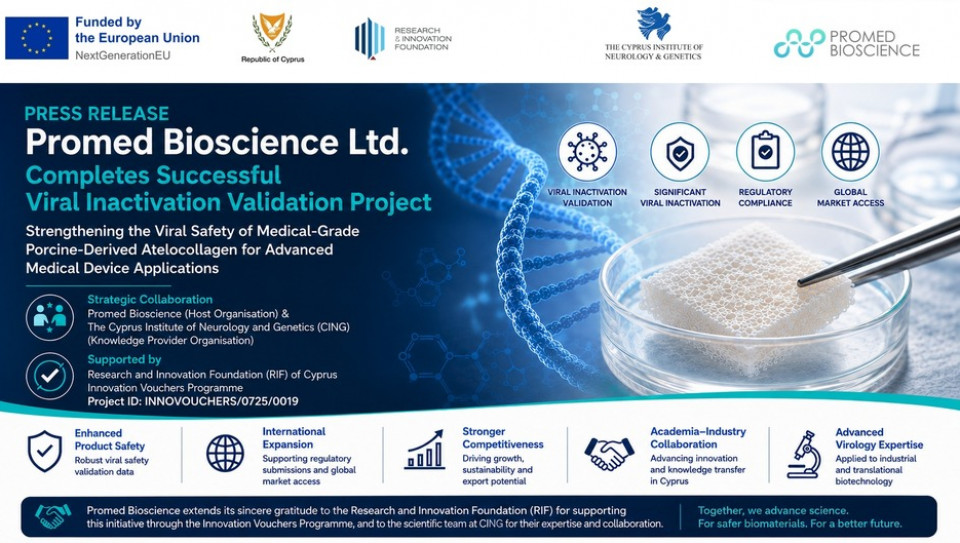
Promed Bioscience Ltd. is pleased to announce the successful completion of its Viral Inactivation Validation Project, implemented with the support of the Research and Innovation Foundation (RIF) of Cyprus under the Innovation Vouchers Programme (Project ID: INNOVOUCHERS/0725/0019).
The project was carried out through a strategic collaboration between Promed Bioscience, acting as the Host Organisation, and the Cyprus Institute of Neurology and Genetics (CING), serving as the Knowledge Provider Organisation. The collaboration aimed to strengthen the viral safety validation of Promed’s medical-grade porcine-derived atelocollagen used in advanced medical device applications.
Promed Bioscience is an ISO 13485 and ISO 9001 certified manufacturer of porcine-derived collagen biomaterials. With the rapid advancements in the medical device and 3D bioprinting sectors, Promed’s highly purified atelocollagen has emerged as a promising biomaterial for advanced biomedical applications. The material is increasingly used as a raw material in medical devices, including tissue engineering scaffolds, dermal fillers, regenerative medicine products, and 3D bioprinted constructs. As the company continues to expand into international and highly regulated markets, compliance with stringent viral safety requirements for animal-derived biomaterials has become critically important.
Through the Innovation Voucher project, CING provided specialized virology expertise and laboratory services required to design and execute a comprehensive viral inactivation validation study aligned with international regulatory expectations and ISO 22442 / ICH Q5 standards for medical devices utilizing animal tissues.
The project included:
- Scientific design of a viral inactivation validation strategy aligned with international regulatory principles.
- Selection of representative model viruses covering diverse genetic and physicochemical characteristics, including RNA and DNA viruses, as well as enveloped and non-enveloped viral models.
- Development and execution of controlled virus-spiking experiments simulating Promed’s collagen manufacturing process.
- Application of advanced molecular detection methods (RT-PCR/qPCR) and infectivity assays (TCID₅₀) for evaluation of viral reduction.
- Statistical analysis and preparation of a comprehensive validation report suitable for regulatory submissions.
The validation study assessed the key viral inactivation steps within Promed’s collagen manufacturing process. The selected viral panel included challenging viral models from different virus families, including Rotavirus A and Porcine Parvovirus (PPV), representing highly resistant non-enveloped viruses relevant to animal-derived biomaterials. The findings of the study demonstrated significant viral inactivation capacity for all viruses through the combined manufacturing process.
The successful completion of the project provides Promed Bioscience with critical regulatory-grade viral safety validation data supporting international regulatory submissions and expansion into global medical device markets. The project contributes directly to strengthening product safety, increasing export potential, supporting long-term business sustainability, and enhancing Promed’s competitiveness as a supplier of validated medical-grade biomaterials.
For CING, the collaboration enabled the application of advanced virology expertise to industrial and translational biotechnology applications, while expanding its service portfolio into viral clearance validation for biomaterials and medical manufacturing processes.
More broadly, the collaboration represents a strong example of successful academia–industry cooperation in Cyprus, demonstrating the value of knowledge transfer mechanisms in driving innovation, strengthening the biotechnology ecosystem, and enhancing the international competitiveness of Cypriot biomaterial production.
Promed Bioscience would like to thank the Research and Innovation Foundation (RIF) for supporting the study through the Innovation Vouchers Programme as well as the scientific team at CING for their expertise and collaboration throughout the project.
The project (INNOVOUCHERS/0725/0019) was funded by the Research and Innovation Foundation, under the «Innovation Vouchers» Programme and through the Recovery and Resilience Facility of the NextGenerationEU instrument.